As a former classroom teacher, let me tell you it does not strengthen my ability to homeschool my children. It is a regularly expressed notion that a degree in education will better equip me to educate my children. Although, interestingly enough, many have stated that while they believe I was an excellent classroom teacher, it would not be adequate for me to teach my own children. So, which is it? Well, the answer is actually neither. I am here to tell you that your ability to educate your children does not lie in a degree, but rather in your ability to see what is in front of you, adapt and allow your child to have a voice that is heard.
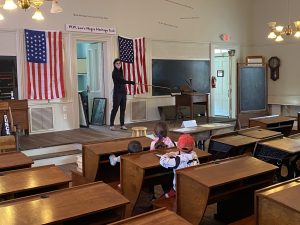
Classroom teaching is first and foremost an important and challenging job that must adhere to limitations that teachers have little influence over. Therefore, teachers must excel in classroom management. To effectively lead a classroom, you need to manage the students and to manage the students you need them all to participate cohesively, like cogs in a machine. Simultaneously, allowing them to be themselves while not disrupting any other students and preparing them for an end goal that was made as generalization for all students of a similar age by people they will likely never meet.
Districts know they can not serve every student, the goal is to manage the classroom the best they can so that the majority get the “necessary” information. Sometimes the job works beautifully and sometimes you’re just trying to survive. I happen to think I was a teacher that excelled in classroom management, but still I taught in classrooms with no heat, had students tower over me in forms of intimation, saw dictionaries go flying out classroom doors. You manage what you can, teach what you can get to, try to do more where you can and hope for the best.
This is where the beauty of homeschooling just begins to shine. You know your children best, you set the tone for your house, you know where they are “academically” and that is where you get to start. You remove unnecessary obstacles so that you can work at their pace, slowing down where need be and skipping for when mastery of concept is shown.
In our house when my children understand a math concept and can explain how to solve it in correct mathematical terminology, we move on, problems get intentionally skipped. Books are read on vents where blankets and stuffed animals often join. When a task gets overwhelming, they first learn to regulate emotions, taking breaks, playing a few minutes of basketball, getting a drink and coming back to the task at hand. The goal is not to get the work done at all cost, the goal is to understand both themselves and the material placed before them.
I did not realize that the amount of time I spent in the classroom was leading me away from adapting to kids’ needs and becoming focused on was it enough, would I get in “all” in.. I set my homeschool up like a classroom and that was a mistake. Not literally with motivational posters and desks, but our day was so over structured with inadequate breaks, too much writing too young, every subject covered everyday, and almost the immediate feeling that I was falling behind.
I let the doubts of others cloud my judgment. I let voices of veteran teachers ring in my head of “how it should be done”, I let naysayers fuel my self doubt, but in reality I had to stop, I was choosing another way, what I thought was better for my family. I had to use my skills to adapt, these are not taught, but learned overtime. Something I truly believe every homeschool parent can learn and achieve, slow down, step back, adjust.
I stopped everything, reevaluated my goals and rebuilt what homeschooling was going to look like for our family. Too often we look at what we can add, but we don’t look at what we can take away. First and foremost, I believe we need to have a clearly defined goal and then move forward in pursuit of that goal. Something I believe many classroom teachers wish they had the freedom and ability to yet, instead we add to their plates.
Year over year, we continue to tweak and adjust based on who is in front of us. Knowing our goals for our children, hearing what goals they have set for themselves and making small consistent steps to making homeschooling work for our family. There is no end goal because there is no end to learning, there will always be gaps in education, consider those gaps an invitation to keep learning. The only person we need to learn to manage is ourselves and the only real test is not on paper but how well we can adapt.